 11
11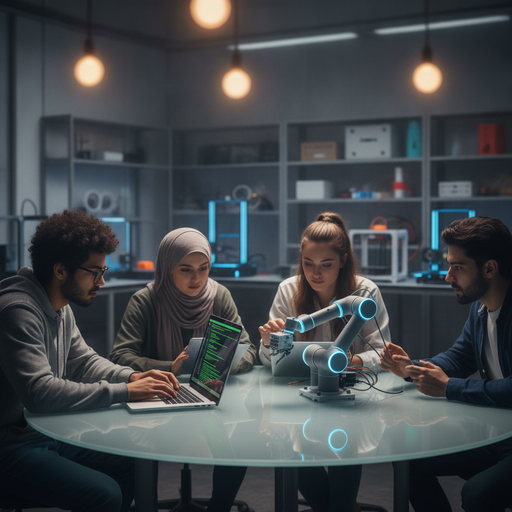
Imagine standing in a room filled with the faint hum of electronics and the rhythmic clicking of gears. On the table before you lies a chaotic assortment of wires, metal plates, and sensors. To an outsider, it looks like a junk pile. But to you, a student of robotics, it is a puzzle waiting to be solved. You upload the final line of code, click ‘Execute,’ and suddenly, the machine stirs. It pivots its arm, identifies a small red block, and gently moves it to a new location. In that single moment of success, you aren’t just watching a machine; you are witnessing your own logic and creativity take physical form. This is the magic of a robotics course.
For many, the word “robotics” conjures images of high-tech laboratories or sci-fi movies where sentient machines take over the world. However, the reality is far more grounded and infinitely more exciting. Robotics is the intersection of several powerful disciplines: mechanical engineering, electrical engineering, and computer science. Taking a robotics course is no longer just a niche hobby for “geeks”; it has become a fundamental pillar of modern education, preparing individuals for a world where automation is the new norm.
When you sign up for a robotics course, you might think you are just learning how to build a remote-controlled car. But the curriculum goes much deeper. A well-structured course is a multidisciplinary journey that challenges both sides of your brain. Here is what you typically encounter:
A robot without software is just a very expensive paperweight. In a robotics course, you learn the languages that bring machines to life. Whether it is Python for high-level logic and AI, or C++ for low-level control of microcontrollers like Arduino and Raspberry Pi, you learn how to think like a programmer. You learn about loops, conditional statements, and variables—not as abstract concepts on a screen, but as instructions that dictate how a physical object moves in three-dimensional space.
How does a robot move smoothly? How do gears transfer torque to lift heavy objects? Mechanics is the study of physical structures. You will learn about degrees of freedom, kinematics, and the properties of different materials. Understanding the physical constraints of your robot is crucial. A robotics course teaches you that a beautiful piece of code caot save a robot that is top-heavy or poorly balanced.
This is where the magic happens behind the scenes. You will learn about circuits, sensors, and actuators. You’ll discover how a robot “sees” the world using infrared or ultrasonic sensors and how it “feels” pressure using touch sensors. Learning to read a schematic and solder a circuit board is a tactile skill that stays with you for life.
One of the most profound benefits of a robotics course is the development of “computational thinking.” In the world of robotics, things rarely work the first time. Your code might have a bug, or perhaps a wire came loose, or maybe the lighting in the room is confusing your robot’s optical sensors. This leads to a process of trial and error that is incredibly educational.
In a robotics classroom, failure is not a dead end; it is data. When your robot spins in circles instead of moving forward, you don’t give up. You troubleshoot. You isolate the variables. Was it the left motor? Was the power supply too low? This iterative process builds a level of resilience and analytical skill that is highly valuable in any career, from medicine to law to business management.
A common fear that prevents people from enrolling in a robotics course is the belief that they need to be a math genius. While robotics does involve math—geometry, trigonometry, and some calculus—it is taught in a way that is far more intuitive than a standard textbook. In robotics, you don’t just calculate an angle because a teacher told you to; you calculate it because you want your robot to turn exactly 90 degrees to avoid hitting a wall. When math has a tangible application, it becomes much easier to grasp and, dare we say, fun.
The skills gained in a robotics course are the bridge to the careers of the future. We are currently in the midst of the Fourth Industrial Revolution, where automation and Artificial Intelligence (AI) are transforming every sector. By understanding how robots work, you position yourself as a creator rather than just a consumer of technology.
Even if you don’t end up becoming a “Robotics Engineer,” the literacy you gain in technology makes you an asset in an increasingly digital workforce. You will understand how to interface with automated systems and how to optimize workflows using technology.
With the rise of online learning, there are more ways than ever to start your journey. If you are a begier, look for courses that offer “project-based learning.” These courses focus on building specific projects, such as a line-following robot or a weather-sensing station. This approach keeps you motivated because you see immediate results.
For children and teenagers, platforms like LEGO Mindstorms or VEX Robotics provide a great entry point with modular parts. For adults and university students, looking into MOOCs (Massive Open Online Courses) from institutions like MIT, Stanford, or specialized platforms like Coursera and Udemy can provide deeper technical knowledge in ROS (Robot Operating System) and advanced AI integration.
Beyond the technical jargon, robotics is a deeply social activity. Most robotics courses involve team projects. You have to collaborate, delegate tasks, and communicate complex ideas clearly to your teammates. You might be the “coder” while your partner is the “builder.” Learning how to synchronize these different roles is a masterclass in project management and leadership.
Taking a robotics course is an investment in your curiosity. It is an invitation to look under the hood of the modern world and understand the forces that are shaping our future. It transforms “I wonder how that works” into “I can make that work.”
Whether you are a student looking for a future-proof career, a professional wanting to pivot, or a hobbyist seeking a new challenge, robotics offers a unique blend of intellectual stimulation and hands-on satisfaction. The barrier to entry has never been lower, and the potential rewards have never been higher. So, pick up that microcontroller, write your first line of code, and start building. The future isn’t just going to happen; it’s going to be built—by people like you.